LD Carlson
Amylase Enzymes for Brewing & Distilling – Alpha-Amylase and Glucoamylase
Amylase Enzymes for Brewing & Distilling – Alpha-Amylase and Glucoamylase
Couldn't load pickup availability
Improve starch conversion in grain, fruit, and other starch-based fermentations with your choice of Alpha-Amylase or Glucoamylase. Each enzyme performs a different role in breaking down starches and preparing them for fermentation.
Choose Your Enzyme
Alpha-Amylase
Alpha-amylase breaks long starch molecules into smaller, more manageable dextrins and sugars. It is commonly used during the heating or mashing stage to liquefy thick, starch-rich mixtures.
- Helps reduce the thickness of grain and starch mashes
- Breaks large starch molecules into shorter sugar chains
- Commonly added during the mash or cooking stage
- Suitable for grain, corn, potato, rice, and other starch-based ingredients
Glucoamylase
Glucoamylase further breaks down dextrins and complex carbohydrates into simpler, fermentable sugars. It is typically used after alpha-amylase or in fermentations where more complete starch conversion is desired.
- Converts dextrins and remaining starches into fermentable sugars
- Helps yeast access more of the available carbohydrates
- May support a drier and more complete fermentation
- Can be added during saccharification or fermentation, depending on the process
Which Variant Should I Choose?
Choose Alpha-Amylase when you need to liquefy a thick mash and begin breaking down raw or gelatinized starches.
Choose Glucoamylase when you need to convert smaller starch fragments and dextrins into simpler sugars that yeast can ferment.
For many grain-based applications, the enzymes may be used in sequence: alpha-amylase first for liquefaction, followed by glucoamylase for further sugar conversion.
How Much Do I Need?
Choose the package size that best fits your brewing or distilling needs. Always follow the instructions included with your selected enzyme.
- 10–15 g Packet – Intended for one standard batch. Use the entire packet according to the package directions. For products with split additions, add approximately 1/3 at the beginning of the mash and the remaining 2/3 later in the process as directed.
- 1 oz (28 g) – A multi-use container for frequent homebrewers and hobby distillers. Typical usage is ½ teaspoon per 5 gallons (19 L), providing enough enzyme for many batches.
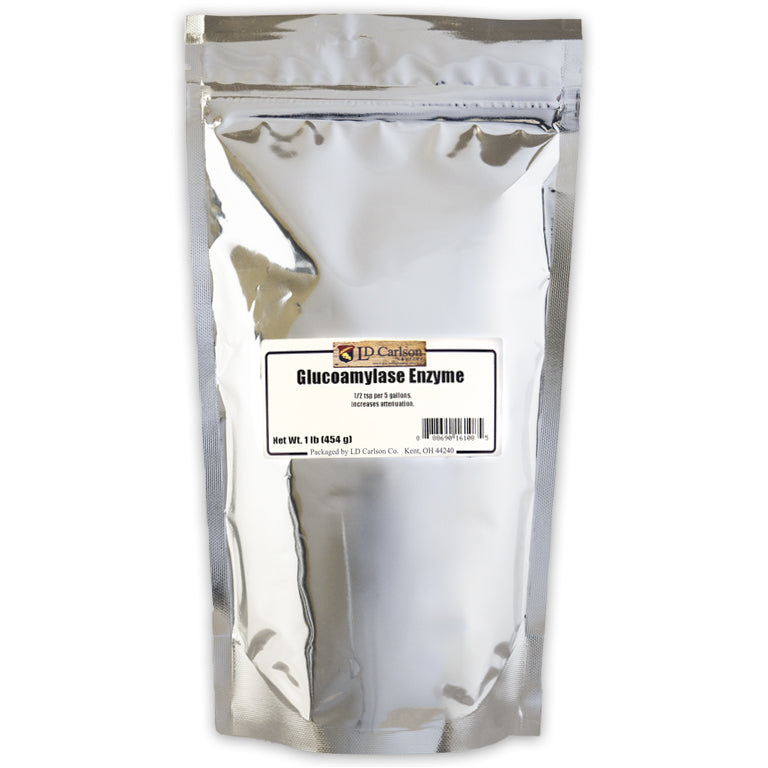
- 1 lb (454 g) – Bulk size for commercial breweries, distilleries, wineries, cideries, or high-volume production. Uses the same dosage rate as the 1 oz container while providing enough enzyme for hundreds of batches.
If you brew only occasionally, the single-use packet is usually the most convenient choice. The 1 oz container is ideal for regular brewing or distilling, while the 1 lb size offers the best value for commercial or frequent high-volume use.
Typical Applications
- Beer and grain brewing
- Distilling and mash fermentation
- Corn, rice, potato, and cereal-based mashes
- Starchy fruit or vegetable fermentations
- High-gravity and dry-finish fermentation recipes
Directions: Follow the instructions provided with your selected enzyme. Single-use packets are intended for one standard batch, while the 1 oz and 1 lb containers are measured by volume (typically ½ teaspoon per 5 gallons (19 L)). Temperature, timing, and dosage may vary depending on the enzyme and your recipe.
These enzymes assist with starch conversion but do not replace yeast. Proper mash preparation, temperature control, sanitation, and fermentation practices are still required.
Share